Ask any traveller what they miss most about Thailand and the answer is almost always the same: the food. Thailand's street-food culture is arguably the best in the world — vibrant, affordable, accessible and so deep that you could eat from a different stall every meal for a year and still not run out of dishes to try.
If it's your first visit, the sheer choice can be overwhelming. This guide breaks down what to order, what it'll cost, how to tell a great stall from a mediocre one, and the cultural etiquette that will get you a smile (and sometimes a free extra spoon of chillies).
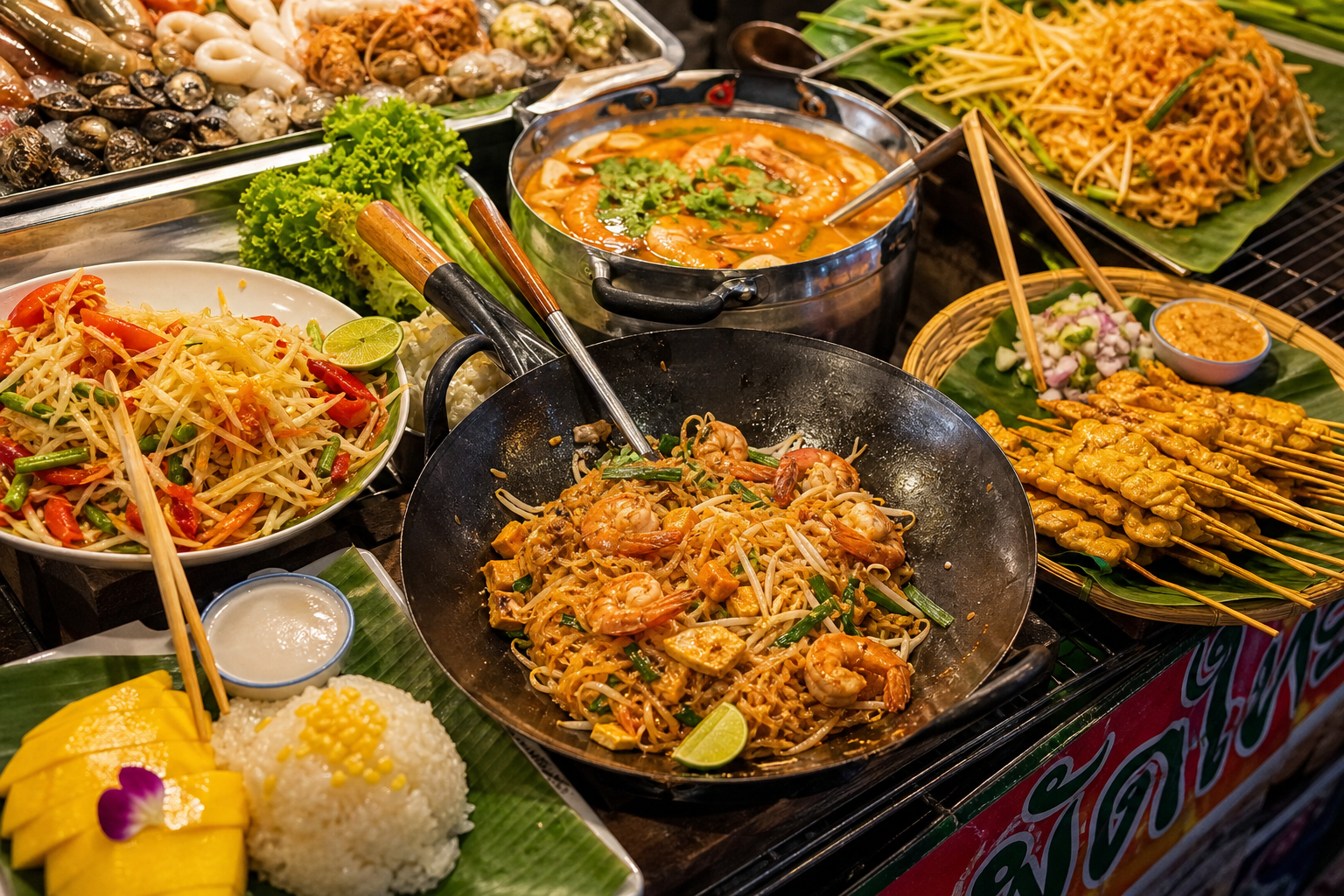
How to find the best street-food stalls
The first rule of Thai street food: follow the locals. A stall buzzing with Thai office workers, taxi drivers and grandmothers is always a safer bet than the one with the photo menu and English signage. Look for these signals:
- Specialist stalls. One dish, done well, every day for 30 years. Almost always better than the all-rounder vendor.
- High turnover. Ingredients are constantly being replenished, nothing sits around.
- Tidy cooking area. Worn equipment is fine. A clean prep area is what matters.
- Local clientele. If office workers walk past the empty seats at the tourist stall to queue 15 minutes at the next one, you should too.
- A queue at lunch. Thailand's lunchtime rush is between 11:30 and 1 pm. If a stall has a line then, it's good.
10 Thai dishes every first-timer should try
1. Pad Thai (ผัดไทย)
Stir-fried thin rice noodles with egg, tofu, prawn or chicken, bean sprouts, peanuts and a tangy-sweet tamarind sauce. Order it with prawns ("pad thai goong") and squeeze the wedge of lime on top yourself. 60–80 baht at a stall, 120–180 in a restaurant.
2. Green papaya salad (Som Tam Thai)
Shredded green papaya bashed in a clay mortar with chilli, lime, garlic, tomatoes, dried shrimp and fish sauce. Order it "noi" (a little spicy) the first time — the standard Thai heat will likely floor you. 50–80 baht.
3. Tom Yum Goong (ต้มยำกุ้ง)
The world's most famous Thai soup — hot, sour and aromatic with prawns, lemongrass, galangal, kaffir lime leaves and chilli. The "Nam Khon" version adds coconut milk for a creamier texture. 100–180 baht.
4. Tom Kha Gai (ต้มข่าไก่)
A gentler cousin of tom yum, this coconut-milk soup with chicken and galangal is creamy, mellow and slightly sweet. A great first-day-in-Thailand dish if you're easing into the spice. 80–150 baht.
5. Green curry (Gaeng Khiao Wan)
Fragrant coconut-based curry with Thai basil, eggplant and chicken (or beef, or fish balls). The colour comes from green chillies. Always eat it with steamed jasmine rice. 80–150 baht.
6. Massaman curry (Gaeng Massaman)
Originally a Muslim-influenced dish from southern Thailand, massaman is mild, rich and slightly sweet with potatoes, peanuts and tender beef or chicken. Often the favourite dish of people who claim they "don't like Thai food". 90–160 baht.
7. Khao Pad (Thai fried rice)
Simple, ubiquitous and almost impossible to mess up. Choose your protein (chicken, prawn, crab or pork) and add a fried egg ("kai dao") on top. 60–100 baht.
8. Pad Krapow Moo Saap
Thailand's unofficial national lunch: stir-fried minced pork with holy basil and chilli, served over rice with a crispy fried egg. Genuinely addictive. 50–80 baht.
9. Khao Soi (ข้าวซอย)
Northern Thailand's signature dish — yellow egg noodles in a coconut curry broth, topped with crispy fried noodles, chicken, pickled mustard greens, shallots and lime. Best in Chiang Mai. 60–100 baht.
10. Mango sticky rice (Khao Niao Mamuang)
Thailand's most beloved dessert: warm coconut-soaked sticky rice with slices of ripe sweet mango. Peak season is April–July. 80–120 baht.
Drinks you have to try
- Thai iced tea (Cha Yen): bright orange, sweet, condensed-milk magic.
- Coconut water from a fresh young coconut: 30–50 baht straight from the husk.
- Cha Manao: Thai-style iced lime tea, less sweet than the orange one.
- Sugar cane juice (Nam Oi): pressed in front of you, refreshing on a hot afternoon.
- Singha or Chang beer: the two most popular local lagers. Both light and easy on a hot evening.
Ordering like a local
You don't need to speak Thai to eat well, but a few phrases will go a long way:
- Mai pet — not spicy
- Pet nit noi — a little spicy
- Pet maak — very spicy (good luck)
- Mai sai pak chee — no coriander/cilantro
- Kep tang duay — the bill, please
- Aroi maak! — very delicious! (always appreciated)
- Khob khun ka / khrap — thank you (women say "ka", men say "khrap")
How much does food cost in Thailand?
A serious advantage of Thailand is how cheaply you can eat extraordinarily well.
- Street stall meal: 50–80 baht (about $1.50–$2.50)
- Casual restaurant meal: 100–200 baht ($3–$6)
- Mid-range restaurant with a drink: 300–500 baht ($9–$15)
- Upmarket Thai restaurant in Bangkok: 1,000–2,500 baht per person ($30–$75)
Food safety: should you worry?
The short answer: not really. Thailand's street-food scene is one of the best regulated in Southeast Asia and millions of tourists eat at stalls every year without issue. A few sensible precautions:
- Stick to busy stalls with high turnover.
- Make sure cooked food is served hot.
- Avoid raw seafood unless you're at a reputable restaurant.
- Drink bottled or filtered water — tap water isn't drinkable.
- Ice in tubes (with a hole through the middle) is factory-made and safe; chipped ice is less reliable.
Regional food highlights
Thai food varies dramatically by region. Hunt these down where you can:
- Northern Thailand (Chiang Mai, Chiang Rai): khao soi, sai oua sausage, nam prik dips.
- Northeastern Thailand (Isaan): som tam, larb, grilled chicken (gai yang), sticky rice.
- Central Thailand (Bangkok, Ayutthaya): curries, stir-fries, the classics.
- Southern Thailand (Phuket, Krabi): seafood, southern curries (massaman, gaeng tai pla), Muslim-influenced dishes.
Take a cooking class
One of the best things any food-loving traveller can do in Thailand is a half-day cooking class. They typically include a market tour, hands-on cooking of 3–5 dishes and lunch (the things you just made). Available in every tourist city for 1,200–1,800 baht.
Before you fly
Every foreign visitor needs to file the Thailand Digital Arrival Card within 72 hours of arrival. Get it sorted before you fly — you've got more important things to think about, like which mango sticky rice stall to hit first.